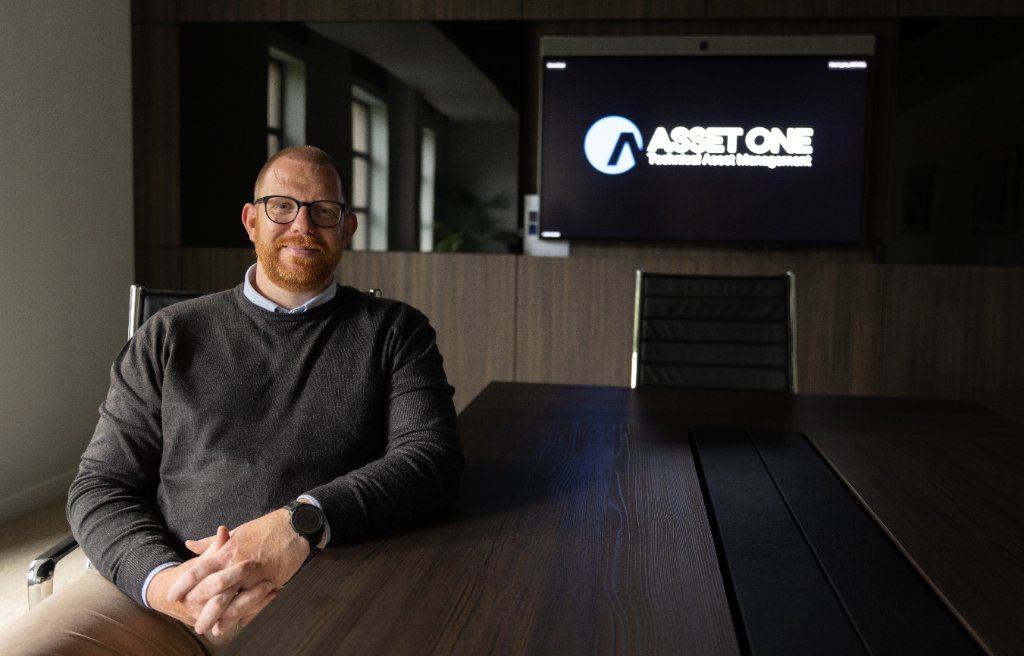
When I founded Asset One in May 2023, I made a deliberate choice.
I didn't want to be another consultancy talking about AI. I wanted to understand it — properly, practically, and honestly.
Over the last three years, that's exactly what we've done. We've built with AI. We've broken things. We've discarded ideas that didn't work. And we've discovered things that genuinely transform how engineers work.
I've changed my own opinion on several aspects of AI during that time. I've learned where it creates real value, where it falls short, and where the hype outweighs the reality.
This article isn't about convincing you that AI is the answer to everything. It's not. It's about sharing what I've learned — honestly — so that your organisation can make informed decisions about where AI fits, and where it doesn't.
AI doesn't replace engineers
One thing that's become obvious to me over the last three years: the fear that AI will replace engineers is misplaced.
AI doesn't remove engineering. It removes administration.
Engineers should be making decisions. Not writing VLOOKUPs. Not comparing spreadsheets. Not manually searching ERP systems for equipment records that don't match. Not checking thousands of maintenance plans one by one to find duplicates.
AI allows engineers to stop being data processors and return to being what they should be: decision makers, technical authorities, verifiers, asset managers.
When you remove the administrative burden, you don't get worse engineering. You get better engineering — because the people qualified to make engineering decisions finally have the time to make them.
What AI is already capable of
Let me be specific, because generalities don't help anyone.
Here's what I've seen AI do in technical asset management — not in theory, in practice:
- Criticality assessments — reviewing thousands of equipment items and producing draft criticality ratings for engineering review
- Maintenance optimisation — identifying maintenance plans that are redundant, excessive, or missing entirely
- PM duplication detection — finding maintenance routines that do the same job three different ways across three different systems
- Equipment with no maintenance plans — flagging assets that have fallen through the gaps
- Comparing P&IDs against asset registers — identifying equipment that exists on drawings but not in the ERP, and vice versa
- Identifying missing equipment — cross-referencing data sources to find gaps
- Detecting inconsistencies across ERP systems — finding the same equipment described four different ways across four different databases
- Spare parts optimisation — analysing consumption patterns, criticality and lead times to recommend stock levels
- Failure data analysis — reviewing years of work order histories to identify failure patterns and recurring issues
- Reliability trend analysis — spotting degradation trends before they become failures
- Asset hierarchy validation — checking that equipment is correctly nested in the right systems and locations
- Drawing comparison — comparing revision after revision of P&IDs, isometrics and datasheets to identify what changed
- Vendor manual comparison — comparing updated manuals against previous versions to identify changes that matter
- Identification of maintenance strategy improvements — suggesting where RCM, FMEA or failure mode analysis should be applied
Many of these activities previously took weeks or months of manual effort. Some were simply never done because the volume of data made them impractical.
Now they can be completed in hours.
That's not a marginal improvement. It's a fundamental shift in what's possible.
Three years of experimentation
From the day Asset One was founded, I wanted us to experiment with AI rather than simply talk about it.
We've spent three years building. Testing. Breaking. Improving. Discarding ideas. Finding better ways.
Sometimes we discovered things that worked brilliantly. Sometimes we discovered ideas that simply weren't suitable for engineering environments.
This practical experimentation has probably taught us more than any number of conferences or webinars ever could.
I'm not interested in AI that sounds impressive in a demo. I'm interested in AI that holds up when the data is messy, the systems don't align, and the engineering consequences are real.
That only comes from doing the work.
Lessons we've learned
I want to be honest about this.
We've learned a huge amount. But we've also realised how much there still is to learn.
AI is developing faster than any technology most of us have experienced. Nobody has all the answers — and anyone who claims they do probably hasn't spent enough time actually building with it.
Here's the hard truth: poor engineering data still produces poor engineering decisions. AI doesn't change that. It exposes the problem faster.
If your asset register is wrong, AI will tell you it's wrong — quickly, across thousands of records. That's not a failure of AI. That's AI doing exactly what it should.
Good engineering still matters. Good governance matters even more.
AI accelerates engineering. It doesn't remove accountability.
Engineering judgement remains essential. Verification remains essential. The difference is that your engineers spend their time verifying and judging rather than collecting and sorting.
Our work with the University of Aberdeen
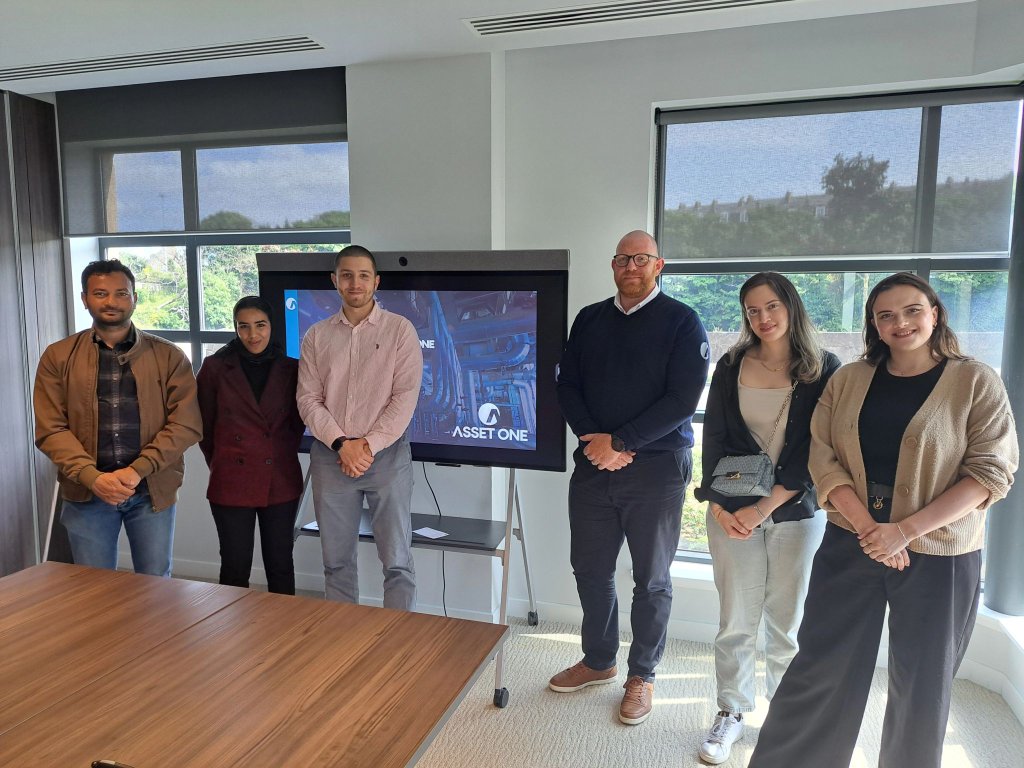
Our three-year collaboration with the University of Aberdeen has been one of the most important things we've done.
The objective was never simply to understand Large Language Models. Anyone can learn what an LLM is.
The partnership has explored how AI can be implemented responsibly across technical asset management — from multiple perspectives: technical, engineering assurance, legal, commercial, governance, organisational change, data ownership, intellectual property, cross-industry learning, risk management.
Understanding implementation is significantly more important than understanding prompts.
Most organisations can learn to write a prompt. Very few understand what it takes to embed AI into an engineering workflow where the outputs actually matter — where a wrong answer has consequences.
That's the gap we've been working to close.
What we've built
I want to share what we've actually built, because I think it demonstrates where genuine value exists.
These weren't built because AI was fashionable. They were built because engineers repeatedly encounter the same time-consuming problems:
- AI-enabled Criticality Assessment tools
- Spare Parts Optimisation tools
- Maintenance optimisation utilities
- Engineering data validation tools
- Digital engineering workbenches
- Engineering AI assistants
The response from customers has been extremely encouraging — not because the tools are clever, but because they remove repetitive work while leaving engineering judgement exactly where it belongs. With engineers.
When an engineer can complete in an afternoon what used to take a week, that's not a nice-to-have. That's a competitive advantage.
Where AI sits in our 10D assessment
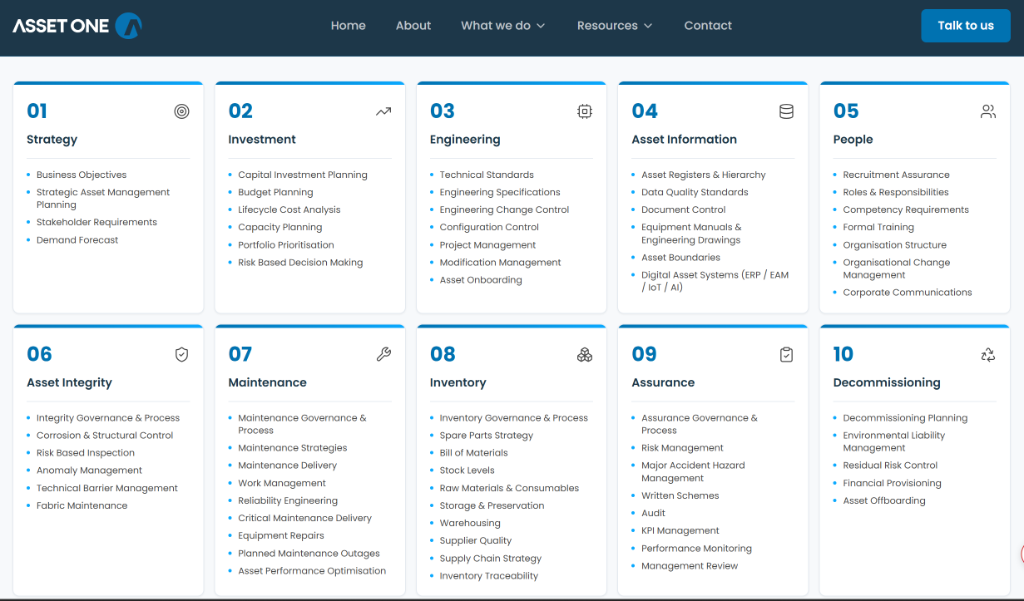
This is also why, when we assess an organisation through our 10 Dimensions to Asset Management® framework, we look at the digital systems our clients rely on — including any AI capabilities already in place or under consideration.
That sits within the fourth dimension, Asset Information, under Digital Asset Systems (ERP / EAM / IoT / AI). We review ERP and EAM platforms, CMMS implementations, IoT infrastructure, and any AI tooling the organisation has started to explore — not as a tick-box exercise, but to understand whether the data foundations will actually support AI adoption, or whether they need to be fixed first.
It's one of the reasons AI adoption fails in so many organisations: the systems and data underneath simply aren't ready. We help identify that before investment, not after.
Learn more about the 10 Dimensions to Asset Management® →
The project that changed our thinking
One project that fundamentally changed our thinking was supporting ADNOC Gas in developing a Large Language Model focused on maintenance and asset integrity.
At first glance, it looked like an AI project. But it wasn't really about AI.
It was about making decades of engineering knowledge accessible to the people making engineering decisions — the kind of knowledge that currently lives in filing cabinets, shared drives, and the heads of people approaching retirement.
The value wasn't in AI itself. The value was unlocking engineering knowledge that already existed.
That project reinforced something I now believe strongly: knowledge management may become one of AI's greatest contributions to engineering.
AI isn't ChatGPT
Here's another misconception I've encountered repeatedly.
Many organisations believe that buying ChatGPT Enterprise or Claude for Work means they've “adopted AI.”
These are excellent tools. We use them every day. But they are one small part of an AI ecosystem.
Buying ChatGPT for your team is not AI adoption. It's a software purchase.
Real transformation comes from embedding AI into engineering workflows. From building tools that understand your data, your equipment, your maintenance strategies, and your operating context.
The organisations that understand the difference will move further and faster than those that don't.
CAIRN
CAIRN is our own example, and it's probably the biggest lesson we've learned.
Internally, we've built CAIRN to manage virtually every aspect of running Asset One: market intelligence, CRM, sales, quotations, projects, resource planning, delivery, lessons learned, business reporting.
AI is embedded throughout CAIRN. But here's the important part.
CAIRN is not simply ChatGPT connected to a database. Nor is it simply Claude for Work.
It is an ecosystem of interconnected workflows, specialist AI agents, engineering tools and business processes. Each component performs a specific task. Together they transform how we operate as a business.
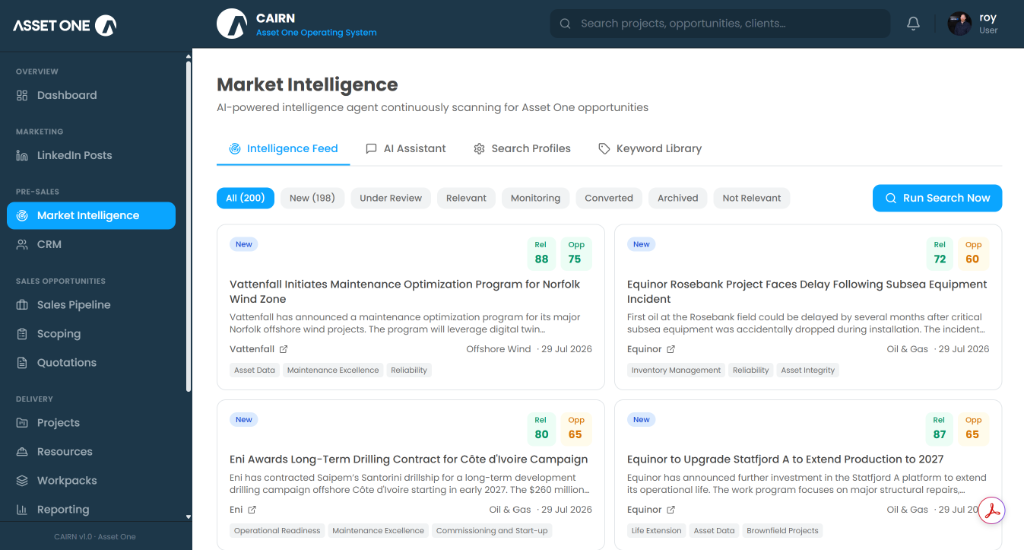
As a result, Asset One now operates far more efficiently than would previously have been possible for a consultancy of our size.
That's probably the biggest lesson I've learned: AI delivers its greatest value when it becomes part of an ecosystem rather than another application sitting on someone's desktop.
How ONEWorkbench was born
Something happened that I didn't expect.
As we developed AI-assist tools internally, we started using them to reduce the cost of our own maintenance engineering services. The heavy lifting — the data analysis, the optimisation identification, the hours of comparing and cross-referencing — was being done by our tools rather than by billable hours.
Our clients got better results, faster, and at a lower cost. It was a genuine win.
Then one of our clients audited us. They wanted to understand how we were delivering so much, so quickly, and at the rates we were quoting. So we showed them. We walked them through the tools, the workflows, and the approach.
Their response surprised me. They didn't ask us to stop. They asked if we could develop the same in-house tools for their business — for their own engineers to use.
That conversation is what led us to develop ONEWorkbench.
ONEWorkbench is now our engineer-focused suite of subscription tools designed to make engineers more efficient. It's built on exactly the same principles as everything else I've described here: it does the heavy lifting so engineers can spend their time on judgement, not data processing.
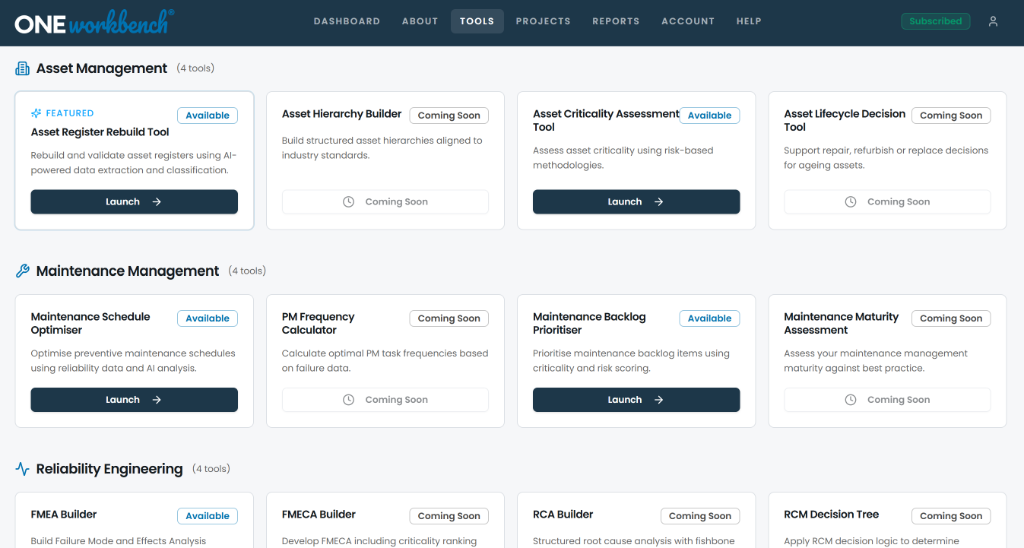
I share this story because it illustrates something important. We didn't set out to build a software product. We set out to deliver better engineering services. The tools were a means to an end. But when you build something that genuinely solves a problem, people notice — and they ask for it.
The challenge for leadership
This section is for CEOs, COOs, CTOs, Engineering Directors, Operations Directors and Boards.
One of the biggest opportunities I see today isn't AI itself. It's educating senior leaders.
The objective isn't turning them into AI experts. It's giving them sufficient understanding to make informed strategic decisions about:
- Governance
- Data ownership
- Engineering assurance
- Legal responsibilities
- Commercial opportunities
- Cross-industry learning
- Validation
- Organisational change
- Workforce confidence
- Responsible adoption
I'm not suggesting every CEO needs to become a data scientist. But leaders who don't understand AI at a strategic level will either over-invest in the wrong things or under-invest in the right ones.
Standards like ISO/IEC 42001 and ISO 55001, alongside guidance from the World Economic Forum, the NIST AI Risk Management Framework, and the UK Government's AI Assurance work, all provide useful reference points. But the key is grounding them in practical engineering, not turning AI into an academic exercise.
The opportunity
I want to be honest about what I'm not saying.
I'm not saying everyone must use AI. If AI helps transform your organisation, excellent. If another technology is more appropriate, that's equally fine.
The objective is always to improve technical asset management and engineering decision making. Technology is simply an enabler.
The biggest risk is not adopting AI. The biggest risk is failing to understand it.
AI represents one of the greatest opportunities technical asset management has ever seen. Not because it replaces people. Because it allows experienced engineers to spend more time applying judgement and less time manipulating data.
That is where the real value exists.
Why we're writing this white paper
One of the things I've become passionate about over the last three years is helping technical asset operators separate the hype from the genuine opportunity.
That is exactly why we're writing this white paper.
It's being co-authored by me, eight University of Aberdeen interns, and University of Aberdeen academic staff.
The objective isn't to predict the future. It's to help organisations adopt AI safely, responsibly and with confidence.
I'll leave you with this:
The future of technical asset management won't belong to organisations with the most AI. It will belong to organisations that understand where AI genuinely adds value, where engineering judgement must always prevail, and how to bring the two together responsibly.